Guides / Alloys
Why Thick Plate Is the Reason 7050 Exists
October 13, 2026 by The Alu CNC Parts editorial desk / how this is checked
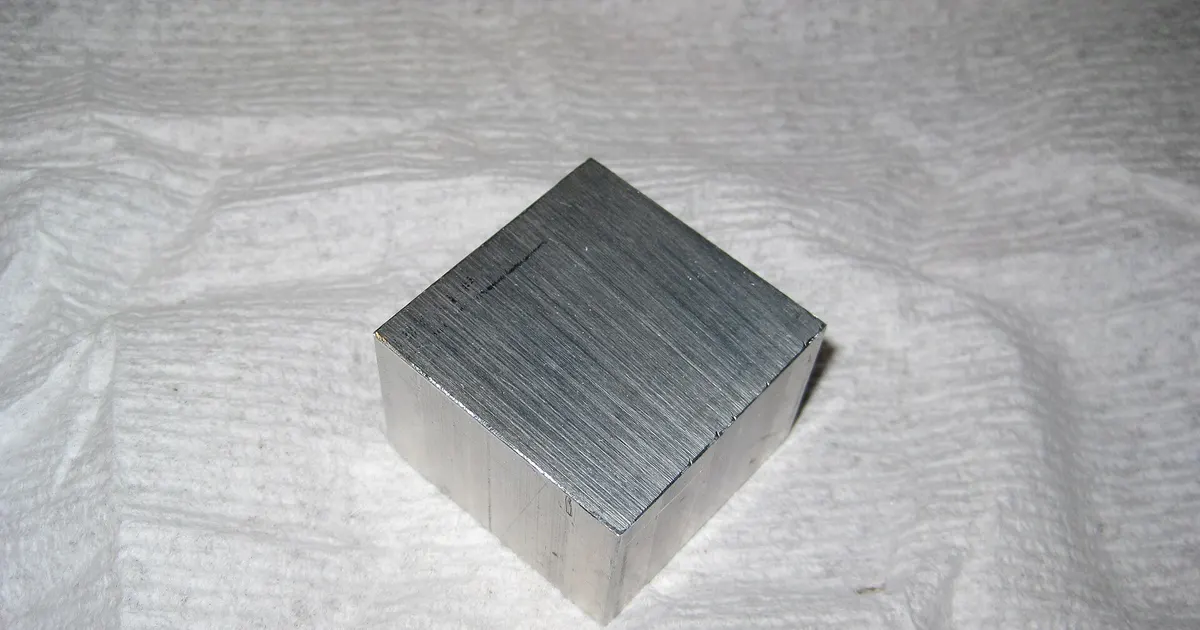
For a 12 mm bracket the choice between 7050 and 7075 hardly matters. For a 100 mm block machined into a bulkhead or a tooling base, it matters a great deal. 7050 was developed to solve a problem that 7075 has in thick sections, and knowing the difference prevents buying the wrong plate, or paying for one you do not need.
The core difference: quench sensitivity
High-strength aluminum gets its properties from heat treatment. The plate is heated, quenched in water and then aged. The quench must be fast enough to lock alloying elements in solution. In a thick plate the center cools slower than the surface, so the center can fall short.
7075 is sensitive to this. As the plate gets thicker, strength, toughness and corrosion behaviour drop toward the core. 7050 uses a different composition, with zirconium in place of chromium and with a different balance of zinc, magnesium and copper. It is less sensitive, so a thick plate of 7050 holds more uniform properties from surface to center.
Typical figures
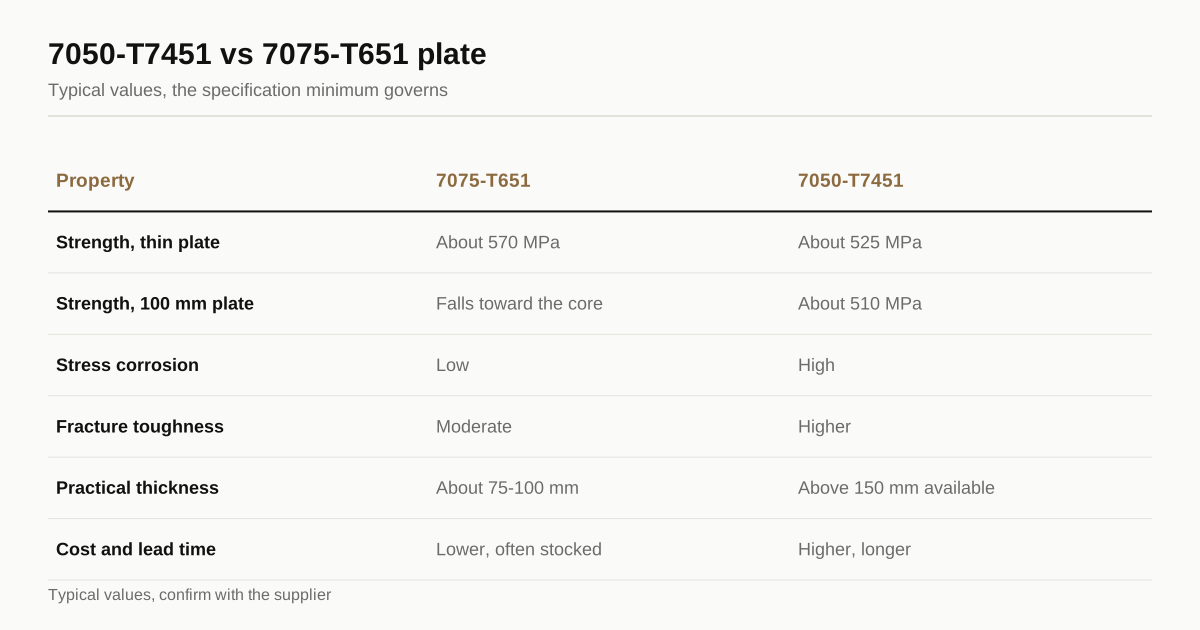
Values are typical for plate and change with thickness and product form. The minimum in the specification governs.
| Property | 7075-T651 | 7050-T7451 |
|---|---|---|
| Tensile strength, thin plate | About 570 MPa | About 525 MPa |
| Tensile strength, 100 mm plate | Lower, falls through thickness | About 510 MPa |
| Yield strength, 100 mm plate | Lower, falls through thickness | About 450 MPa |
| Stress corrosion resistance | Low | High |
| Fracture toughness | Moderate | Higher |
| Maximum practical plate thickness | About 75 to 100 mm | Above 150 mm available |
Notice that 7050-T7451 starts lower at thin gauge, since it is overaged. It wins in thick sections, because 7075-T651 loses more.
Where each alloy fits
7075-T651. Plate up to about 50 mm, parts of moderate thickness, machine components, tooling plates, sporting goods and housings. It is easy to find, quick to buy and cheaper. 6061 versus 7075 explains where it sits next to the more common alloys.
7075-T7351. Same alloy, overaged for stress corrosion resistance, at somewhat lower strength. Covered in 7075-T6 versus T73.
7050-T7451. Thick plate for structural parts such as aircraft bulkheads, wing components and large forgings. It is the default for thick sections in the industry, where strength must hold in the center and corrosion resistance matters.
Why thick plate affects machining
Thick plate holds a lot of material to remove. A part machined from a 100 mm plate down to a thin web may remove 90 percent of the stock. That has three consequences:
- Residual stress release. A thick plate machined heavily on one side will move. T7451 is stress relieved by stretching, which helps. Why aluminum parts warp covers the rest.
- Machine time. High removal rates matter. Both alloys machine similarly, so cutting parameters are close.
- Chip volume. Both alloys produce long chips on deep pockets. High speed machining lists the method used to evacuate them.
Cost and availability
7050 costs more than 7075. The alloy itself is more expensive, the processing is more careful and fewer mills make it. For a small buyer, three practical issues show up:
- Minimum order quantity. Mills sell plate in full sheets or by the lot. Service centers cut it, at a markup.
- Lead time. 7050 plate can take weeks, where 7075-T651 is often in stock.
- Certification. Aerospace parts need mill certificates, heat lot traceability and often a conductivity check. Mill certs and traceability explains the paperwork.
If a design does not need 7050, the saving by choosing 7075-T651 is significant. If the part is thick and loaded, it can be false economy.
When 7050 is worth it
Look for these conditions:
- Plate thickness above 50 mm, where 7075-T651 loses properties.
- High through-thickness stress, such as a press-fit hub or a bolted joint.
- A requirement for high toughness or fatigue crack growth resistance.
- A customer or specification that calls out the alloy.
- A part that will see wet or corrosive conditions under load.
If none of these apply, 7075-T651 or T7351 is the normal choice.
Reading a plate certificate for a thick section
A thick plate certificate carries more information than a bar certificate. Look for these items:
- Product form and thickness. The properties in the specification depend on thickness. A plate of 100 mm is tested against the line for that thickness range, not the thin plate line.
- Test direction. Tensile results are given for the longitudinal, long transverse and short transverse directions. The short transverse values are lower and are the ones that matter for through-thickness loading.
- Test location. For thick plate, specimens are taken from mid thickness, since that is where the properties are lowest.
- Conductivity. In percent IACS, to confirm the overaged temper.
- Heat lot and lot number. These tie the plate to the finished part.
A buyer who asks for these items on the quote gets a clearer answer from each shop. If a supplier cannot provide mid-thickness test results for a thick plate, treat that as a flag.
A worked example
A fixture base is to be machined from a plate 120 mm thick, with pockets cut from the top face leaving a 20 mm floor. The base carries a bolted load across the thickness and sits in a washdown area.
7075-T651 at this thickness has a core with lower strength than the surface, and lower resistance to stress corrosion. The pockets cut through the surface layer and expose the weaker core. With 7050-T7451, the core properties remain close to the surface, the overaged temper resists stress corrosion cracking and the stress relief reduces movement after pocketing. The plate costs more per kilogram, but the part is less likely to move or crack. For a part this size, the premium is small against the machining time, which is the larger share of the final price.
Machining and finishing
7050 machines much like 7075, with similar tool life and a slightly softer cut in the overaged temper. Anodizing works on both. 7050 can look a touch different in colour than 7075 after dyeing, so a mixed set of parts needs checking. See anodize colour consistency.
Chem film suits both alloys when conductivity is needed. See chem film versus anodize.
Common mistakes
Calling out 7075 and receiving 7050, or the reverse. A shop that has 7050 in stock may offer it as a “better” alloy. It is not automatically acceptable, since a drawing or a customer specification fixes the alloy. Ask for approval in writing.
Specifying T6 on thick plate. The temper name does not say how far the properties drop at the core. For thick sections, name the thickness range and the specification.
Ignoring the short transverse direction. Parts loaded through the thickness need the short transverse values, not the headline strength.
Skipping stress relief. A thick plate in a temper without the 51 suffix will move when machined. Plate for machined parts should carry T651, T7351 or T7451.
How to write it on a drawing
The material note must name the alloy, the temper and the product form:
MATERIAL: 7050-T7451 PLATE PER AMS 4050.
CERTIFICATE WITH HEAT LOT AND CONDUCTIVITY REQUIRED.
MACHINE FROM PLATE, NO SUBSTITUTION WITHOUT APPROVAL.
AMS 4050 is the commonly cited plate specification for 7050-T7451. Check the current revision and any customer specification before you quote it. If a substitution is acceptable, say which alloy and which temper, so the shop quotes the options.
Checklist before you order
- Plate thickness known, with the finished thickness after machining.
- Alloy and temper named on the drawing, with the specification.
- Through-thickness stress direction identified.
- Stress relieved temper requested, 7451 or 7351.
- Certificate and conductivity requirements written.
- Lead time and minimum order checked before the quote is accepted.
Send the drawing and plate thickness through the RFQ form. Up to three shops quote against your material note, and replies arrive within 24 business hours.
Sources
Figures in this guide are checked against the following. Published values are typical ranges for test material, not a guarantee for your part.
Frequently asked questions
Is 7050 stronger than 7075?
In thin sections the two are close, with 7075-T651 slightly higher in peak strength. In thick plate, 7050 keeps its strength through the section while 7075 loses strength toward the center, so 7050 is the stronger choice above about 50 mm.
What does T7451 mean?
T74 is an overaged temper that gives better stress corrosion resistance than T6. The 51 means the plate was stretched after quenching to reduce residual stress. T7451 is a common temper for 7050 plate.
Can 7050 replace 7075 on an existing drawing?
Not without approval. The two alloys differ in composition, heat treatment and certification. A change needs the part owner to accept it, and the drawing and certificate should show the new alloy.
Need a quote for a part like this?
Send the drawing or photos. We match you with up to 3 shops and reply within 24 business hours.
Get matched with a shop