Guides / Alloys
Giving Up 10 Percent of Strength to Stop a Crack That Starts Alone
October 16, 2026 by The Alu CNC Parts editorial desk / how this is checked
A bracket in 7075-T6 passes every test on the bench and cracks in service months later, with no overload to explain it. The cause can be stress corrosion cracking, and the cure on the drawing is one extra character in the temper: T73 instead of T6. The price is some strength.
What the two tempers are
Both start with the same alloy, a high-strength aluminum, zinc, magnesium and copper composition. The difference is in the final heat treatment.
- T6. Solution heat treated and artificially aged to peak strength. Highest strength, lowest resistance to stress corrosion.
- T73. Solution heat treated and then overaged in a longer, hotter cycle. Lower strength, much better resistance to stress corrosion cracking.
- T76. An intermediate overage. Less strength loss than T73, better corrosion behaviour than T6. It is less common.
For plate, the stress relieved versions are T651 and T7351. The “51” means stretched to relieve residual stress, as covered in the temper guide.
Typical properties
Typical published values for plate are in the table. They are examples, not guarantees. The minimums in the specification are lower.
| Property | 7075-T651 | 7075-T7351 |
|---|---|---|
| Tensile strength | About 570 MPa | About 505 MPa |
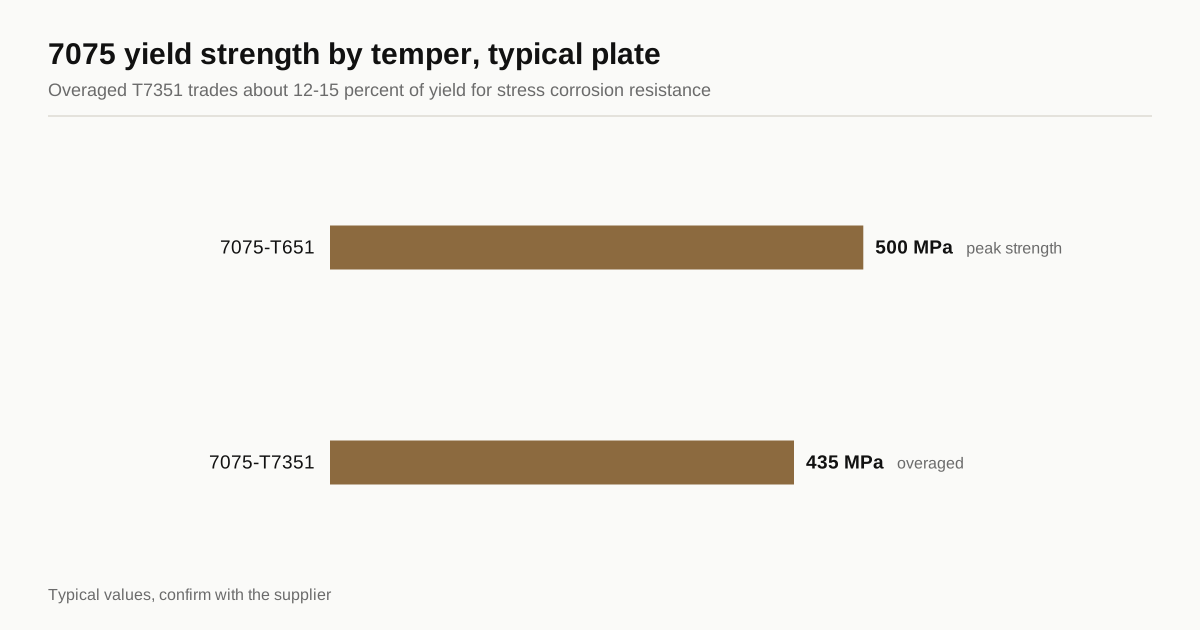
| Yield strength | About 500 MPa | About 435 MPa |
| Elongation | About 11 percent | About 13 percent |
| Electrical conductivity | About 31 to 33 percent IACS | About 40 to 43 percent IACS |
| Stress corrosion resistance | Low in the short transverse direction | High |
| Fracture toughness | Lower | Higher |
Yield drops by about 12 to 15 percent. That is enough to change a stress margin, so a part sized for T6 should be checked before the temper changes.
What stress corrosion cracking is
Stress corrosion cracking, or SCC, needs three things at once: a susceptible alloy and temper, a sustained tensile stress and a corrosive environment such as humid air with chlorides. Under those conditions a crack can grow with no load increase, and it can run for months before failure.
In 7075-T6 the weak direction is the short transverse, through the thickness of a plate or forging. A press fit, a bolted joint that pulls across the grain or a residual stress from machining all create sustained tension. The part does not need to see a high load. A pre-load from a bolt is enough.
Overaging changes the microstructure at the grain boundaries so that cracks cannot run as easily. That is why T73 is the temper that aerospace and defence specs call out for parts with sustained stress in the short transverse direction.
When to specify T73
Look for these conditions. If two or more apply, T73 or T7351 is the safer choice:
- A press fit or an interference fit in a machined bore.
- A threaded insert or a bolted joint with high pre-load across the thickness.
- A thick section, say above 50 mm, where the short transverse direction is exposed.
- A humid, marine or de-iced road environment.
- A safety-related application where failure has a high cost.
- A forging or a thick plate machined asymmetrically, which leaves residual stress.
For a short-lived part, a dry indoor assembly or a cosmetic or low-stress use, T6 or T651 is acceptable and cheaper. 6061 versus 7075 covers the case where neither temper is needed.
Cost and availability
T73 costs more than T6 in most markets, since it needs a longer heat treatment cycle and a smaller supply chain. Lead time can be longer in plate sizes that mills do not stock. Many shops quote T651 by default and need a prompt to quote T7351.
For small orders, the stock form matters. Aluminum stock forms explains how plate, bar and extrusion differ, and bar and plate sizes in T73 can be harder to find than T651.
Proving the temper
The temper must be shown on the mill certificate, and a conductivity or hardness check can back it up. Mill certs and traceability describes what a certificate should list.
For T73 on safety critical parts, a typical request is:
- Mill certificate with temper stated.
- Conductivity reading on the machined part or the stock, in percent IACS.
- Hardness reading, usually Brinell or Rockwell B.
- Heat lot traceability from stock to finished part.
A conductivity limit separates T73 from T6, and the exact value is in the specification for the alloy and form. Do not use a general number from a web page in place of the spec your part needs.
Design choices that reduce SCC risk in either temper
Switching temper is one fix. Layout changes can reduce the risk as well, and cost nothing if made early:
- Orient the part so sustained load runs along the rolling direction, not through the plate thickness. A bracket cut from plate with its long axis in the rolling direction behaves better than one cut with the thickness carrying the pull.
- Avoid interference fits across the short transverse direction. A bore in the face of a thick plate with a press-fit pin loads the hoop stress across the weak direction.
- Use sealant or a barrier coat at joints. Keeping chlorides out of crevices removes one of the three conditions.
- Shot peen or stress relieve where allowed. Compressive surface stress resists crack starts. The process must be named in the drawing.
- Keep machining stress low. Light final cuts and symmetric material removal leave less residual tension. See why aluminum parts warp.
Example: a clamp block
A clamp block in 7075 holds a shaft with a bolt that pre-loads the block across its 40 mm thickness. In T651 the part meets the static load many times over, so strength is not the issue. The pre-load is a constant tensile stress across the short transverse grain, in a damp workshop. That combination is the textbook SCC case. Moving to T7351 lowers the yield by about 65 MPa, still far above the working stress, and removes the failure mode. The same block cut from 6061-T651 would not crack, but it would be about 40 percent weaker. The choice depends on the design margin, and it is worth a short calculation before release.
Machining and finishing differences
Machinability is similar. T73 is slightly softer, which helps tool life a little and gives a marginally better finish. Both tempers machine well compared with many steels, with chip control as the main issue. Built-up edge is less common in 7075 than in soft alloys.
Anodizing works on both. Type II gives a dense, dark coating on 7075, and a hardcoat is possible. Colour can differ slightly between the two tempers, so if a part must match a T6 assembly, ask for a sample. See anodize colour consistency for why alloy and temper change colour.
How to write it on a drawing
State the alloy, the temper and the product spec:
MATERIAL: 7075-T7351 PLATE PER ASTM B209 OR EQUIVALENT.
CERTIFICATE WITH TEMPER AND CONDUCTIVITY REQUIRED.
If either T6 or T73 is acceptable, say that too. A drawing with “7075” only invites the cheapest option, which may be T6. If the temper matters, the drawing should say it, and the buyer should say what the part is used for. A shop that knows the application can advise on alternatives.
Checklist before you order
- Temper named, T651 or T7351 for plate.
- Strength margin checked at the lower T73 values.
- Sustained stress direction known, especially across the plate thickness.
- Certificate and conductivity requirement written on the drawing.
- Stock availability and lead time confirmed.
- Surface protection planned, anodize or chem film.
Send the drawing with the temper requirement through the RFQ form, and up to three shops will quote against it, replying within 24 business hours. More alloy data is on the 7075 profile.
Sources
Figures in this guide are checked against the following. Published values are typical ranges for test material, not a guarantee for your part.
Frequently asked questions
Is 7075-T73 the same as T7351?
They are related. T73 is the overaged temper. T7351 is the same overaged temper with stress relief by stretching, used for plate. T73 and T7352 appear on forgings. Machined parts from plate usually say T7351.
How much weaker is T73 than T6?
Typical published values put T73 yield and tensile strength roughly 10 to 15 percent below T6. Minimum guaranteed values are in the specification for the product form and thickness, not in a general table.
Can I tell T6 from T73 by looking at it?
No. The two tempers look the same. The usual check is electrical conductivity, since overaging raises it, plus a hardness test. The mill certificate should state the temper and, for T73, conductivity results.
Need a quote for a part like this?
Send the drawing or photos. We match you with up to 3 shops and reply within 24 business hours.
Get matched with a shop