Guides / Alloys
The Alloy That Cuts Cleanly and Corrodes Quickly
October 9, 2026 by The Alu CNC Parts editorial desk / how this is checked
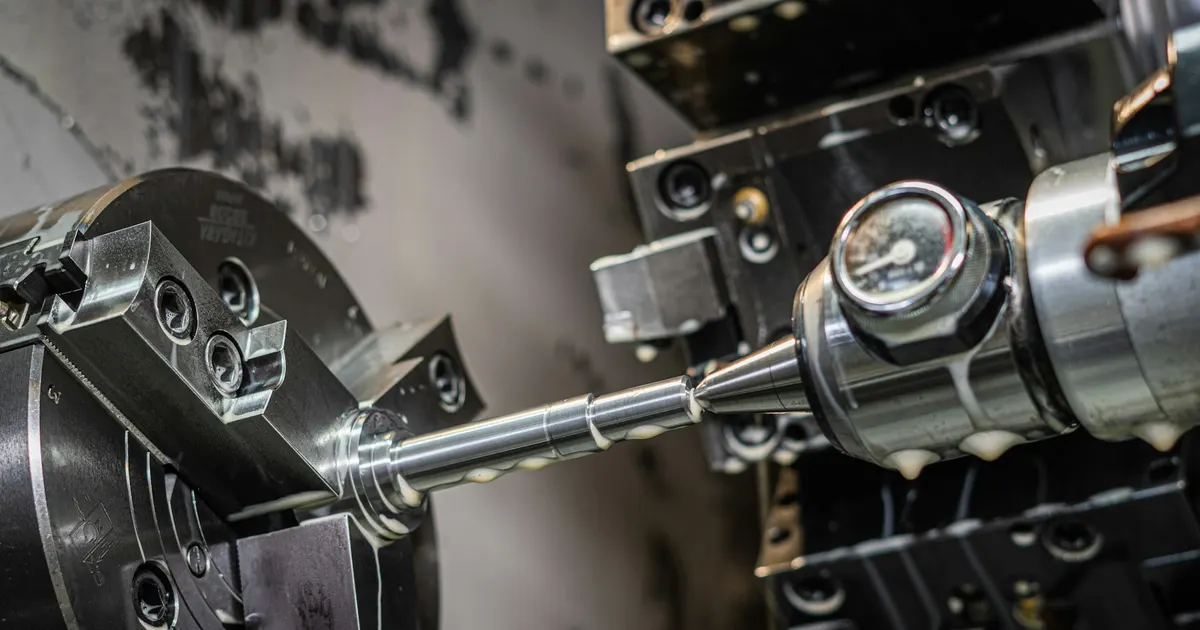
A turning shop quoting 10,000 small fittings will often ask whether the part can be made in 2011. The answer saves a lot of machine time, and it also brings limits that matter for corrosion, finish and compliance.
What 2011 is
2011 is an aluminum and copper alloy with additions of lead and bismuth, made for free machining. It is sold mostly as round bar in the T3 and T8 tempers and used for screw machine parts, fittings, fasteners and small components made in volume.
Typical composition is roughly 5 to 6 percent copper, with 0.2 to 0.6 percent each of lead and bismuth. The lead and bismuth do not dissolve in the aluminum. They sit as soft particles that act like tiny chip breakers.
What it does at the tool
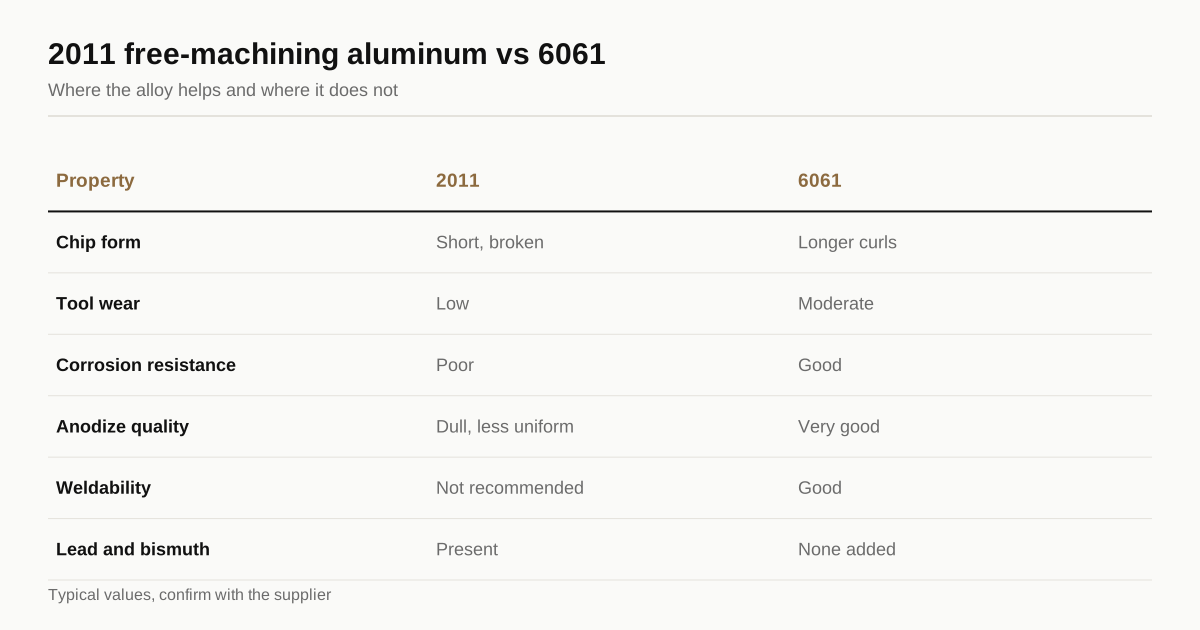
| Property | 2011 | 6061 |
|---|---|---|
| Chip form | Short, broken chips | Longer curls, can string |
| Tool wear | Low | Moderate |
| Surface finish off the tool | Fine, Ra 0.4 to 0.8 um possible | Ra 0.8 to 1.6 um typical |
| Cycle speed on a lathe | Highest of common aluminum alloys | Slower, needs chip control |
| Threading and tapping | Clean, sharp threads | Can tear in soft tempers |
| Unattended running | Reliable | Chip jams more likely |
A shop making long runs on a Swiss-type lathe or an automatic screw machine will often choose 2011 for these reasons. Short chips fall away from the tool instead of wrapping around it, which means fewer stops.
Typical mechanical properties
Typical published values for bar:
| Temper | Tensile strength | Yield strength | Elongation |
|---|---|---|---|
| 2011-T3 | About 380 MPa | About 295 MPa | About 15 percent |
| 2011-T8 | About 405 MPa | About 315 MPa | About 12 percent |
These are comparable with 6061-T6 at 310 MPa tensile and 276 MPa yield. The bar is often stronger in the as-drawn T3 state, which makes it a good option for small high-load parts that do not have to be anodized.
Where 2011 is a poor choice
Corrosion. The copper content makes it much more vulnerable than 6061 or 5052. In damp or salty conditions, 2011 pits and corrodes faster. Marine aluminum shows what a corrosion-resistant alloy looks like by comparison. A protective finish helps, but does not make 2011 suitable for marine use.
Anodizing. The coating forms, but it is thinner, duller and less uniform. Hardcoat on 2011 can burn at the surface. If appearance or wear resistance matters, 6061 or 6082 is a better pick. See Type II vs Type III for how coating quality depends on alloy.
Welding. 2011 cannot be welded in a reliable way. The lead and bismuth cause hot cracking and weak joints.
Forming and bending. The alloy cracks when bent sharply, because the soft particles reduce ductility. Do not choose it for parts that need cold forming or crimping.
Clear finish and chem film. Chem film works, with a more variable colour. See chem film vs anodize.
Lead, bismuth and compliance
Lead is the key issue. Electronics, consumer products and many industrial products sold in Europe fall under RoHS or similar rules. Some aluminum alloys have an exemption for lead up to a stated limit, and the typical 2011 composition range can sit above that limit. Other markets and product classes have their own rules. Buyers for such products should ask for the exact composition from the mill certificate and check it against the rule that applies.
The pipe, drinking water and food contact sectors have stricter limits. 2011 is not a choice for those uses. Mill certs and traceability explains what a certificate lists, and a request for composition along with temper is reasonable.
Stock forms and sizes
2011 is mostly a bar alloy. Round bar is the common form, with hex and square bar available in some sizes. Plate and sheet are rare and not a good fit for a machined aluminum part that needs flat stock. If your part starts as a plate, a different alloy is the realistic choice. Aluminum stock forms explains how the form affects both price and the choices open to the shop.
Bar sizes in T3 are cold drawn to a close diameter tolerance, which saves a turning pass. A 10 mm bar can be bought at a diameter tolerance of a few hundredths of a millimetre, enough for some parts to be cut off and finished with little further work.
Handling and cleaning
The same properties that help chips break up make lead-bearing swarf a handling issue. Shops that run 2011 keep chips separate from other alloys so that recycling streams stay clean, and they wash parts well since fine particles of lead and bismuth can sit on the surface. For parts that go into a clean assembly, a final wash and a particle count may be worth requesting.
A realistic comparison
Take a bushing of 12 mm diameter and 20 mm length, with a through bore and a thread at one end, made in a quantity of 20,000.
| Item | 2011-T3 | 6061-T6 |
|---|---|---|
| Cycle time on a Swiss-type lathe | About 20 seconds | About 28 seconds |
| Tool changes over the run | Fewer | More |
| Thread quality | Sharp, clean | Acceptable, burr risk |
| Finish | Chem film | Clear anodize |
| Corrosion margin | Low | High |
The cycle difference of eight seconds on 20,000 parts is about 45 machine hours. That is real money, and it explains why volume shops favor 2011 when the part allows it. The price for the saving is a more limited finish and a narrower set of uses. The figures above are illustrative, since actual cycle times depend on the part, the machine and the tooling.
Alternatives that machine well
If 2011 is ruled out by corrosion or compliance, several alloys give a middle path.
| Alloy | Machinability | Corrosion | Anodize | Note |
|---|---|---|---|---|
| 6262-T9 | Very good | Good | Good | Contains lead and bismuth, better corrosion than 2011 |
| 6020 | Good | Good | Good | Lead-free free-cutting option, check supply |
| 6061-T6 | Fair to good | Good | Very good | Needs chip control on long runs |
| 2024-T351 | Good | Fair | Fair | See 2024 machining |
For lead-free work, 6020 or a standard 6061 with a good chipbreaker toolpath are the usual choices. The extra machine time costs less than the risk of a compliance failure.
How to choose
Ask three questions in order:
- Does the part run in a damp, salty or chemically active setting? If yes, skip 2011.
- Does the part need a decorative or wear coating? If yes, 6061 or 6082 is safer.
- Is the part sold into a market with lead limits? If yes, check the exemption before you choose 2011.
If all three answers are no, 2011 can reduce cost on volume turned parts. A small fastener or a bushing inside a dry assembly is a good example. See aluminum machining cost for how cycle time drives price.
How to write it on a drawing
State the alloy, temper, product form and the finish:
MATERIAL: 2011-T3 ROUND BAR PER ASTM B211.
FINISH: CHEM FILM. NO ANODIZE.
CERTIFICATE WITH COMPOSITION REQUIRED.
If you do not mind which free-machining alloy is used, write “2011-T3 or 6262-T9” and let the shop quote both. That gives a price range and an honest comparison.
Checklist before you order
- Environment checked for corrosion risk.
- Finish chosen with the alloy in mind, chem film over anodize for 2011.
- Compliance rule identified, with lead content confirmed.
- Part geometry reviewed, no bending or welding.
- Volume large enough that cycle time savings matter.
- Alternate alloy listed on the drawing where acceptable.
Send the drawing with the material options through the RFQ form. Up to three shops quote and reply within 24 business hours.
Sources
Figures in this guide are checked against the following. Published values are typical ranges for test material, not a guarantee for your part.
Frequently asked questions
Why does 2011 machine so well?
It contains small additions of lead and bismuth that form soft particles in the metal. Those particles make the chip break into short pieces instead of long stringy curls, so lathes and screw machines run unattended with less jamming and lower tool wear.
Can 2011 be anodized?
It can be, but the result is weaker than on 6061. The high copper content and the lead and bismuth particles give a duller, less uniform coating and lower corrosion resistance. Chem film is often used where a protective finish matters more than looks.
Does 2011 contain lead that affects RoHS?
It can. Typical 2011 limits for lead are higher than the 0.4 percent that some aluminum exemptions allow. Parts for products sold under RoHS or similar rules need the exact composition and the exemption status checked.
Need a quote for a part like this?
Send the drawing or photos. We match you with up to 3 shops and reply within 24 business hours.
Get matched with a shop