Guides / Alloys
Soft, Clean and Gummy: What 1100 and 3003 Do at the Cutter
October 5, 2026 by The Alu CNC Parts editorial desk / how this is checked
A drawing arrives with “aluminum 1100” in the material box, because the part is a heat exchanger plate, a reflector or a chemical tank fitting. The shop that machines it learns quickly that the softest alloys in the catalogue are not the easiest to cut.
What the alloys are
1100. Commercially pure aluminum, at least 99.0 percent aluminum with a small amount of copper. It has the highest corrosion resistance, high thermal and electrical conductivity and excellent formability. Strength is low.
3003. Aluminum with about 1.2 percent manganese and a little copper. It keeps most of the corrosion resistance and formability of 1100 with higher strength, and it is the common choice for general sheet and plate where moderate strength is needed.
Both are non-heat-treatable. Strength comes from cold work, which gives the H tempers, or from annealing, which gives O.
Typical properties
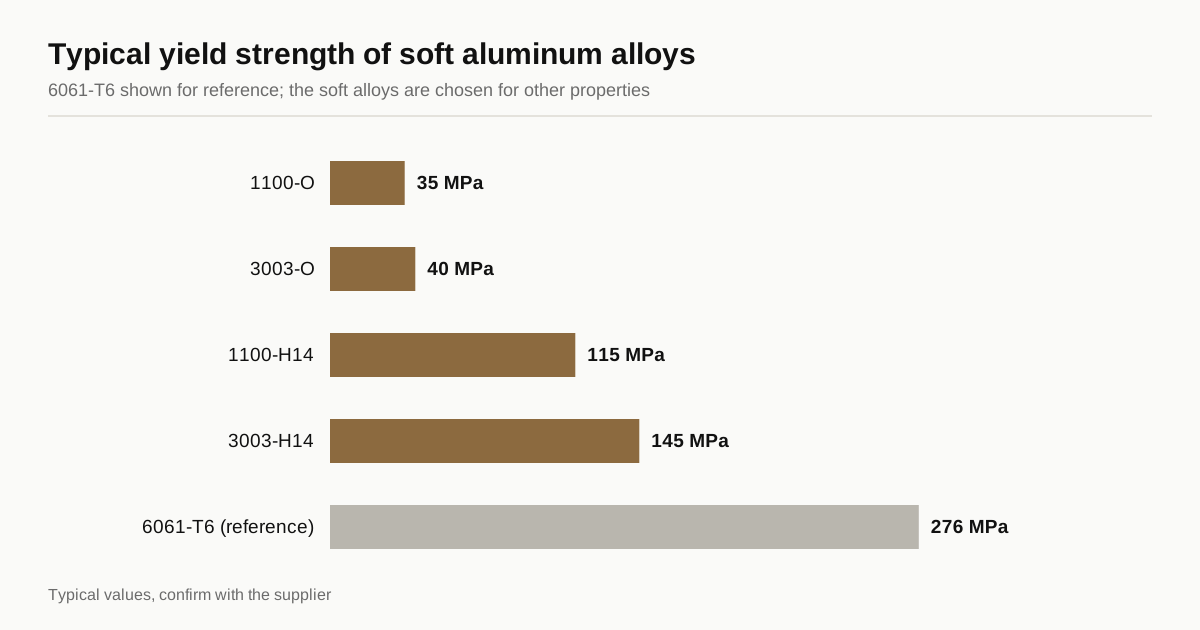
These are typical published values. The minimum in the product specification is lower.
| Alloy and temper | Tensile strength | Yield strength | Elongation | Electrical conductivity |
|---|---|---|---|---|
| 1100-O | About 90 MPa | About 35 MPa | About 35 percent | About 59 percent IACS |
| 1100-H14 | About 125 MPa | About 115 MPa | About 12 percent | About 57 percent IACS |
| 3003-O | About 110 MPa | About 40 MPa | About 30 percent | About 50 percent IACS |
| 3003-H14 | About 150 MPa | About 145 MPa | About 8 percent | About 41 percent IACS |
| 6061-T6, for reference | About 310 MPa | About 276 MPa | About 12 percent | About 43 percent IACS |
The O temper is very soft. A part in 1100-O dents with a thumbnail and bends under its own weight if thin. The H14 temper is a half-hard cold worked condition and is much better for machining.
Why they are hard to machine
Soft alloys do not cut like harder grades. The three main problems are:
- Gummy chips. The material stretches and smears instead of breaking. Chips come off in long ribbons that wrap around tools and spindles.
- Built-up edge. Aluminum welds to the cutting edge. This is the same issue described in built-up edge on aluminum, at a higher intensity.
- Large burrs. Ductile material folds over at every exit, so edges need more work. See deburring aluminum parts.
Soft material also moves away from the cutter. Thin walls bend, and holes drill oversize with a rough wall.
What helps the cut
Shops that machine these alloys regularly rely on a few habits:
- Sharp polished tools with a high rake angle and large clearance, no honed edges.
- High surface speed to carry the chip away, with enough feed so that the edge cuts.
- Generous lubrication. Flood coolant, or cutting oil on small parts, keeps the chip from welding.
- Harder temper where the design allows. H14 or H16 machines much better than O.
- Light finishing cuts and support under thin parts.
- Tapping with a form tap instead of a cutting tap, since forming makes stronger threads in soft metal.
If the design permits, a part that must start in O for forming can be machined in H14 and annealed after. That is a process decision to make with the shop.
Stock forms and availability
1100 and 3003 are mostly sold as sheet, plate and coil. Bar is possible, though less stocked. Thick plate, above about 25 mm, is limited. If your part starts from thick stock, check availability before design is final. Aluminum stock forms explains how the form changes cost.
Anodizing and finishing
1100. Gives a clear, bright anodize, even dye uptake and a bright finish, which suits decorative reflectors and trim. The coating is relatively soft because the metal is soft underneath.
3003. Takes anodize, though manganese particles give a greyer or streaked look. Buyers who need a good colour match should test a sample. See anodize colour consistency.
Hardcoat. Possible on both alloys, but the coating is supported by a soft substrate, so it can crack or dent under point load. Hardcoat on soft alloys does not provide the wear resistance it gives on 6061. See Type II versus Type III.
Where they belong
The alloys are chosen for properties other than strength:
| Need | Why 1100 or 3003 |
|---|---|
| Corrosion resistance in chemicals | High resistance in neutral and many chemical environments |
| Heat transfer | High thermal conductivity, about 220 W/m K for 1100 |
| Formability | Bends and draws without cracking |
| Welding | Weldable by common methods |
| Cost | Low material price per kilogram |
| Electrical conduction | 1100 has the highest conductivity among common alloys apart from 1350 |
Typical uses include heat exchanger plates, chemical tanks, reflectors, gaskets and shims. For load-bearing machined parts, 6061 or 7075 is the usual choice. See 6061 versus 7075 for those.
Fixturing soft parts
Soft parts distort in the vise before the cutter touches them. A thin 1100-O plate clamped hard bows and then springs back after unclamping, so the finished part is not flat. Shops that handle these alloys use light clamping, soft jaws that match the part profile, vacuum plates for flat parts or a sacrificial backing plate under thin sheet. Double-sided tape or a bonded fixture can hold a thin sheet for light profiling without clamping stress.
Soft alloys also take marks. A vise jaw leaves an impression, a stack of parts scratches each other and a hand dropped on a clean face leaves a dent. If cosmetic quality matters, the shop should use film on the faces, separators between parts in transit and gloves. A note on the drawing, “protect surfaces A and B from marking”, is cheap and effective.
Surface finish and Ra
Soft alloys can give a smooth surface when the cut is clean, but the same tool that gives Ra 0.8 um in 6061 can give Ra 3 um in 1100-O if built-up edge forms. A realistic default for a general machined face in H14 is Ra 1.6 to 3.2 um. If the face needs a better finish, say so and expect extra passes or a polishing step. The Ra guide shows how finish and price relate.
A short example
A heat exchanger plate of 3003-H14, 8 mm thick, needs 40 shallow channels milled in one face, with a flat sealing land around the edge. The channels are 3 mm wide and 2 mm deep. The shop runs light finishing passes with a sharp two-flute cutter, flood coolant and a vacuum fixture. Burrs form along every channel edge, so a deburring pass with a brush follows, and the plate is checked for flatness, since the soft metal bows easily. The sealing land is the critical surface and carries the flatness and finish requirement. Writing “sealing land flat within 0.1 mm, Ra 1.6 um max” on the drawing tells the shop where to spend effort, and the channels, which only carry fluid, get a looser requirement.
When to choose a harder alloy
Switch alloy if the part has any of these features:
- Thin walls, below about 1.5 mm, that must stay straight.
- Threads that carry load or must survive repeated assembly.
- Sharp edges that must stay sharp.
- A wear surface or a sliding fit.
- Tight tolerances, below about 0.05 mm, on features that deflect under cut.
Soft alloys can hold tolerances, but the process cost goes up, since the shop spends time on light cuts and care. The tolerance guide shows what is cheap and what is not.
How to write it on a drawing
MATERIAL: 3003-H14 PLATE PER ASTM B209.
MACHINE IN H14 TEMPER. NO FORMING AFTER MACHINING.
BREAK ALL EDGES 0.3 MM. NO BURRS.
If the part is formed after machining, say so, since the shop must keep the cut features in the zone that bends.
Checklist before you request quotes
- Alloy and temper named, with H14 preferred for machining.
- Reason for choosing a soft alloy written down, for example conductivity or corrosion.
- Thin walls and fine threads flagged.
- Edge break and burr limits stated.
- Finish chosen with the alloy in mind.
- Stock form and thickness confirmed.
Send the drawing with the material and temper through the RFQ form. Up to three shops quote, and replies come within 24 business hours.
Sources
Figures in this guide are checked against the following. Published values are typical ranges for test material, not a guarantee for your part.
Frequently asked questions
Why do 1100 and 3003 machine badly?
They are soft and ductile, so chips stretch and smear instead of breaking. Material welds to the cutting edge, burrs grow large and thin features bend away from the tool. Sharp tools, high rake angles and good lubrication help, and a harder temper such as H14 cuts cleaner than O.
Is 3003 stronger than 1100?
Yes. 3003 contains manganese, which raises strength by roughly 30 to 40 percent over 1100 in the same temper. Both are far weaker than 6061-T6.
Do these alloys anodize well?
1100 gives a clear, bright anodize and takes dye evenly, which makes it popular for decorative parts. 3003 anodizes to a greyer, sometimes streaked result because of manganese particles.
Need a quote for a part like this?
Send the drawing or photos. We match you with up to 3 shops and reply within 24 business hours.
Get matched with a shop